How the Bond Market Affects Mortgage Rates
Most people shopping for a mortgage don’t spend much time watching the bond market.
That makes sense. If you’re buying a home, you’re probably more concerned with questions like:
- How much can I afford?
- What will my monthly payment be?
- Could mortgage rates change before I close?
But the bond market sits quietly in the background of all of those questions.
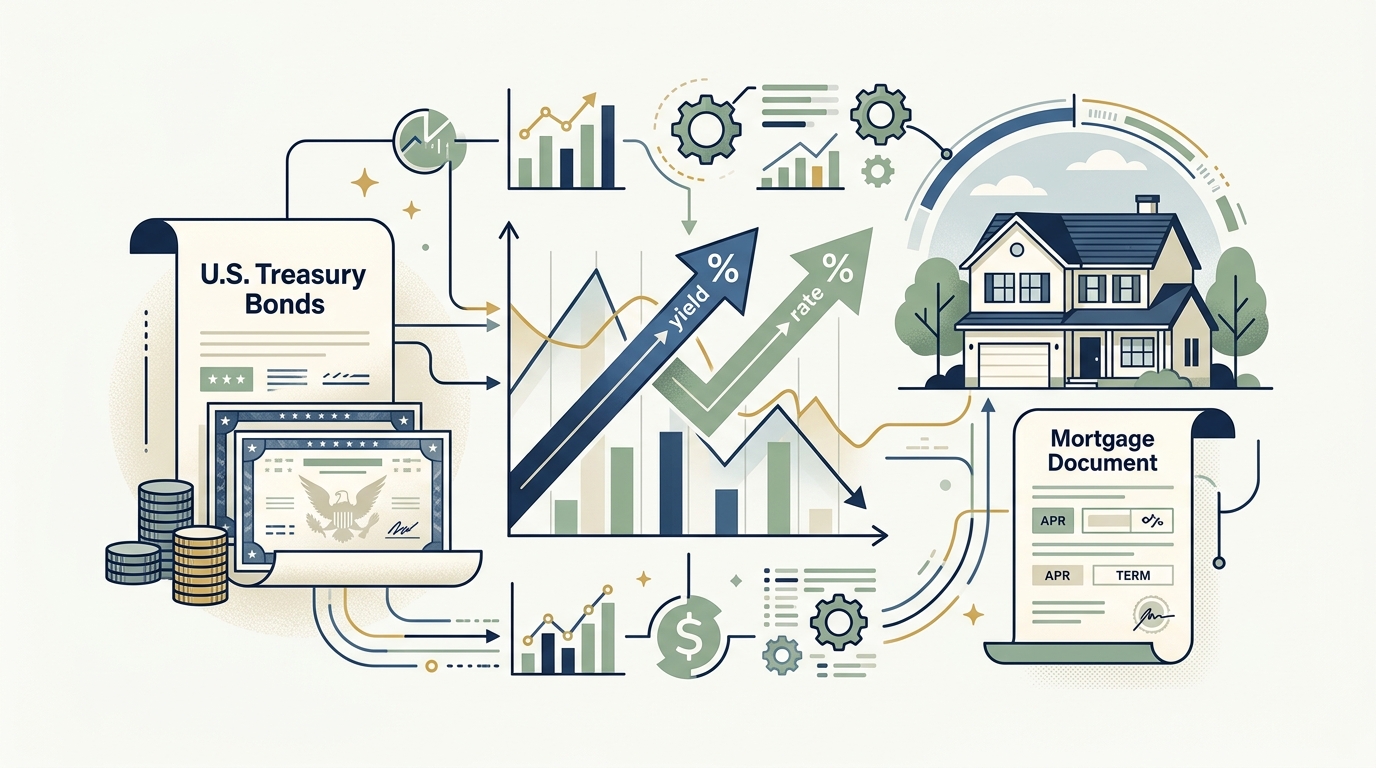
When Treasury yields rise, mortgage rates often move higher. When yields fall, mortgage rates may come down. The relationship isn’t perfect, and it isn’t immediate, but the connection is strong enough that anyone following mortgage rates will eventually run into the same question:
Why does the bond market matter when I’m trying to buy a house?
The answer starts with how lenders and investors think about long-term money.
Mortgage Rates Don’t Move Only Because of the Fed
One of the most common misconceptions about mortgage rates is that they simply follow the Federal Reserve.
The Fed matters, of course. Its decisions influence borrowing costs across the economy. But a 30-year mortgage is not a short-term loan, and mortgage lenders are looking far beyond the next Fed meeting.
Markets are constantly making bets about inflation, economic growth, future interest rates, and the demand for long-term investments.
Those expectations show up in the bond market.
That’s why you can sometimes see mortgage rates move even when the Federal Reserve hasn’t changed anything.
The market may already be reacting to what investors think will happen next.
For more on the factors that can influence mortgage pricing, see our Mortgage Rates Guide.
Why Everyone Watches the 10-Year Treasury Yield
If you follow financial news, you’ll often hear analysts mention the 10-year Treasury yield.
It matters because it reflects what investors expect about inflation, economic growth, and interest rates over a longer period of time.
A 30-year mortgage obviously lasts longer than 10 years, so the connection can seem strange at first.
The reason is that most mortgages don’t actually stay around for 30 years.
People move. They sell their homes. They refinance. Some homeowners make extra payments and pay their loans off early.
Because of this, the average life of a mortgage is often much shorter than the 30-year term printed on the loan agreement.
The 10-year Treasury yield isn’t a mortgage-rate calculator, but it provides a useful signal about where the market thinks long-term borrowing costs are heading.
When that yield starts climbing, mortgage lenders usually take notice.
A Higher Treasury Yield Can Mean Higher Mortgage Rates
Imagine investors suddenly become more concerned about inflation.
If inflation stays high, the money investors receive years from now will have less purchasing power. To compensate for that risk, investors may demand higher returns from long-term bonds.
Bond yields rise.
Higher Treasury yields can then put pressure on mortgage rates.
That doesn’t mean a mortgage rate will automatically increase by exactly the same amount.
For example, a 0.50% increase in the 10-year Treasury yield does not automatically mean a 0.50% increase in mortgage rates.
There are other moving parts.
But the general direction often matters.
When long-term borrowing costs across the market are rising, it becomes harder for mortgage rates to ignore that trend.
For a homebuyer, even a small change can matter.
A difference of 0.25% or 0.50% may not sound significant when looking at a headline, but it can have a noticeable effect on a large mortgage balance.
Changing the interest rate on the same loan with a Mortgage Calculator is one simple way to see how those small changes can affect the numbers.
Mortgage Rates Are Usually Higher Than Treasury Yields
Here’s where the relationship becomes more complicated.
Mortgage rates don’t simply mirror Treasury yields.
A lender has to account for risks and costs that don’t apply in the same way to a U.S. Treasury security.
One important factor is the mortgage-backed securities market.
After mortgages are originated, many are bundled together and sold to investors as mortgage-backed securities, or MBS.
Those investors face risks that Treasury investors don’t face in quite the same way.
One of them is prepayment.
Suppose mortgage rates fall sharply.
Homeowners who already have higher-rate mortgages may refinance.
From a homeowner’s perspective, that’s great.
For an investor holding mortgage-backed securities, it can be less convenient. The mortgage may be paid off earlier than expected, and the investor has to find somewhere else to put that money, possibly at a lower interest rate.
That uncertainty is one reason mortgage rates generally include a spread above Treasury yields.
A simple way to think about it is:
Treasury yield + mortgage market spread = a starting point for mortgage rates
It isn’t an exact formula, and it won’t tell you the rate your lender will offer tomorrow.
But it explains why mortgage rates and Treasury yields often move in the same direction without moving by exactly the same amount.
The Spread Matters Too
Sometimes Treasury yields fall, but mortgage rates don’t fall very much.
Other times mortgage rates move faster than Treasury yields.
The difference between the two is often referred to as the mortgage spread.
That spread can widen or narrow depending on what’s happening in financial markets.
Market volatility, investor demand for mortgage-backed securities, lender capacity, and general uncertainty can all play a role.
This is why watching only one number—the 10-year Treasury yield—doesn’t give you the complete picture.
It’s a useful signal.
It isn’t a crystal ball.
Why Bond Yields Rise in the First Place
Bond yields can rise for several reasons, but inflation is usually one of the biggest things investors watch.
Higher-than-expected inflation can lead investors to believe that interest rates may need to stay higher for longer.
Strong economic data can have a similar effect.
If the economy appears stronger than expected, investors may decide that future interest-rate cuts are less likely—or that they will happen later than previously expected.
Government borrowing can also affect the market.
When the government needs to issue large amounts of debt, investors may demand higher yields to absorb that supply.
None of these factors works in isolation.
Markets are constantly changing their expectations.
That’s why a single inflation report, employment report, or major policy announcement can sometimes move Treasury yields quickly.
Mortgage rates don’t necessarily react at the same speed, but lenders are watching the same market.
And When Yields Fall?
The reverse can happen when investors become more optimistic about inflation or more concerned about economic growth.
If markets begin expecting lower interest rates in the future, longer-term Treasury yields may decline.
Investors may also move toward Treasuries during periods of uncertainty.
More demand for bonds can push bond prices higher and yields lower.
That can create room for mortgage rates to come down.
Again, though, there is no guarantee that the full move will show up immediately in mortgage quotes.
Mortgage-backed securities and lender pricing still matter.
That’s why you may see headlines saying Treasury yields fell sharply while mortgage rates barely moved.
The connection is real. It’s just not mechanical.
Why a Fed Rate Cut Doesn’t Always Lower Mortgage Rates
This is another point that surprises a lot of homebuyers.
The Federal Reserve can cut rates, and mortgage rates can still move higher.
How?
Because markets often move before the Fed.
If investors were already expecting a rate cut, that expectation may already be reflected in Treasury yields.
What matters after the announcement is whether the Fed says something different from what the market expected.
If the Fed cuts rates but signals that inflation remains a concern, investors may start expecting fewer cuts in the future.
Treasury yields can rise.
And mortgage rates may follow.
The same thing can happen in reverse.
The Fed might leave rates unchanged, but mortgage rates could fall if markets become convinced that cuts are coming later.
This is why waiting for the next Fed meeting isn’t always the best way to predict what will happen to mortgage rates.
The bond market is already making its own prediction every day.
What This Means If You’re Buying a Home
You don’t need to start checking Treasury yields every morning.
But if you’re actively shopping for a mortgage, understanding the broader direction of the bond market can help explain why your lender’s quote changes from one week to the next.
More importantly, don’t build your entire home-buying plan around the hope that rates will fall.
Instead, test a few different scenarios.
What happens if your rate is 0.5% higher than expected?
What if rates fall enough to make refinancing attractive later?
What happens if you choose a different loan term?
Running those numbers can give you a clearer idea of whether a payment fits your budget today.
If the payment only works under the assumption that mortgage rates will fall in the future, the home may already be stretching your budget too far.
Bond Markets Matter to Existing Homeowners Too
The bond market isn’t only relevant when you’re buying a home.
Existing homeowners often watch mortgage rates because changes in the market can create refinancing opportunities.
A lower rate can reduce the interest you pay over time, but refinancing isn’t automatically worth it.
Closing costs matter.
The remaining balance matters.
So does the amount of time you expect to keep the loan.
If you’re thinking about replacing your current mortgage, a Loan Refinance Calculator can help you compare the potential savings with the cost of taking out the new loan.
You can also use an Amortization Calculator to see how the balance changes over time and how much of each payment goes toward principal and interest.
Sometimes a refinance that looks attractive based on the monthly payment alone may tell a different story when you look at the full loan.
Should You Wait for the Bond Market to Calm Down?
Probably not as your only strategy.
Bond markets can move quickly, and nobody can tell you with certainty where Treasury yields will be next month.
Even if yields fall, home prices could change.
Competition for homes could increase.
Your own financial situation could change as well.
For most buyers, the more useful question is:
Can I comfortably afford this home at the rate available to me today?
If the answer is yes, future changes in mortgage rates can always be evaluated later.
If rates fall significantly, refinancing may become an option.
If rates rise, you’ll be glad you didn’t depend on a future rate cut to make the numbers work.
The Bottom Line
The bond market may feel far removed from the process of buying a home, but it plays an important role in determining the borrowing environment mortgage lenders operate in.
The 10-year Treasury yield is one of the most closely watched signals for long-term mortgage rates.
When yields rise, mortgage rates often face upward pressure.
When yields fall, mortgage rates may have room to decline.
But the relationship isn’t one-to-one.
Mortgage-backed securities, market volatility, lender pricing, and your own financial profile all affect the final rate you receive.
The useful takeaway isn’t that you should try to predict the bond market.
It’s that mortgage rates don’t move randomly.
There is a larger financial system behind the number your lender quotes you.
Understanding that relationship can make mortgage-rate headlines easier to interpret.
And when you want to see what a different rate means for an actual loan, you can compare the numbers with a Mortgage Calculator.
This article is for educational purposes only and should not be considered financial or mortgage advice. Mortgage rates, loan terms, and borrowing costs vary based on market conditions, lenders, and individual borrower qualifications.