What Happens When You Make Extra Payments on a Loan?
An extra $50 or $100 may not look like much next to a five- or six-figure loan balance. But when that money is applied directly to principal, it can do more than make your balance look a little smaller. It can reduce the amount of interest that builds up in future months and help you pay off the loan sooner.
There is one important catch: the benefit depends on your loan’s interest method and how your lender applies the extra money. Before sending an additional payment, check the contract and make sure the extra amount is being credited the way you intend.

Why an extra principal payment can save interest
Most fixed-rate installment loans are designed around an amortization schedule. Each scheduled payment covers the interest due for that period, then uses the remaining amount to reduce the principal balance. As the balance gets smaller, the interest portion of later payments generally gets smaller too. More of each regular payment can then go toward principal.
An extra payment aimed at principal speeds up that process. You reduce the balance sooner, which leaves less principal for the lender to charge interest on during later periods. The scheduled payment usually stays the same; the loan simply reaches a zero balance earlier.
This is why it helps to look beyond the monthly payment. The Amortization Calculator can show how principal, interest, and the remaining balance change over a loan’s scheduled term. Use that schedule as a baseline before comparing an extra-payment plan.
A $20,000 loan example: what an extra $100 a month can do
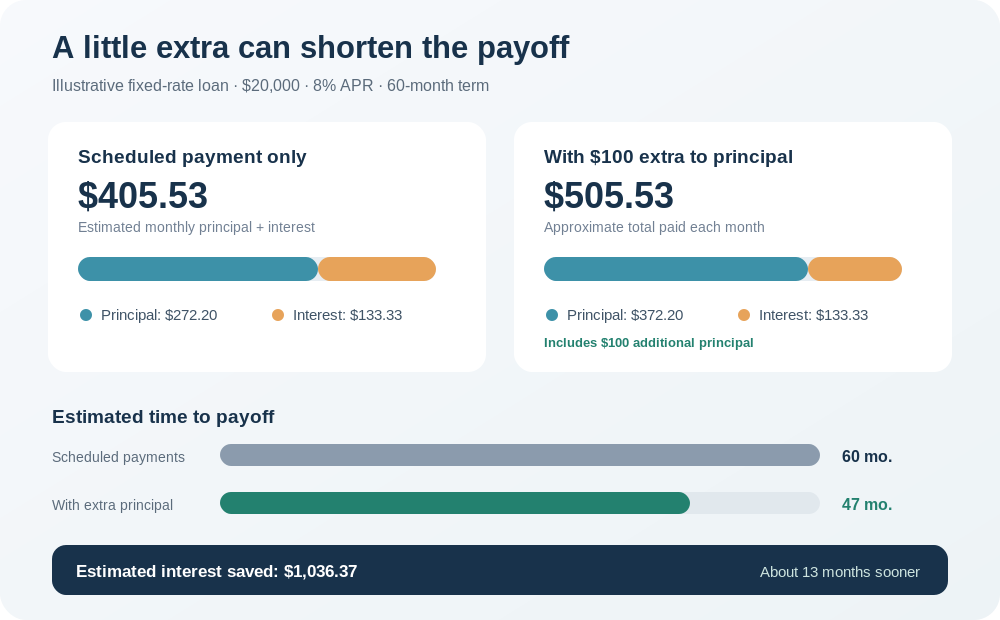
Imagine a borrower takes out a $20,000 fixed-rate installment loan with an 8% APR and a 60-month term. Using a standard monthly amortization calculation, the estimated scheduled principal-and-interest payment is about $405.53.
Now imagine the borrower pays an additional $100 toward principal every month, bringing the regular monthly outlay to about $505.53 until the final, smaller payment.
| Estimate | Scheduled payments only | With $100 extra toward principal |
|---|---|---|
| Monthly payment at the start | $405.53 | About $505.53 |
| Estimated payoff time | 60 months | About 47 months |
| Estimated total interest | $4,331.62 | $3,295.25 |
| Estimated interest saved | — | $1,036.37 |
| Time saved | — | About 13 months |
In this example, the extra $100 a month cuts roughly 13 months off the repayment period and saves about $1,036 in interest.
These are estimates, not a lender payoff quote. The example assumes a fixed 8% rate, monthly interest calculated at APR divided by 12, payments made on schedule, no additional fees or prepayment penalty, and every extra $100 applied immediately to principal. A lender that calculates interest daily, posts payments on different dates, or uses another interest method may produce a different result. The final payment will also be smaller than the usual monthly amount.
The takeaway is not that every borrower will save $1,036. It is that even a modest extra payment can have a measurable effect when it reduces the balance on which future interest is calculated.
How to make sure the extra money reduces principal
Do not assume that sending more than the amount due automatically means the difference will reduce principal immediately. Depending on the loan and the servicer’s payment system, an additional amount may be treated as an advance payment or handled under the contract’s payment-allocation rules.
Before you make an extra payment:
- Check the loan agreement. Look for sections covering extra payments, principal payments, prepayment, and fees.
- Ask how to designate the payment. Your lender may have a separate “principal-only” option or instructions for adding extra principal to an ordinary payment.
- Confirm how the payment is posted. Ask whether the extra amount reduces principal now or is held as a credit toward a future installment.
- Review the next statement. Check that the principal balance fell by the amount you expected and that the payment was not simply used to move your next due date forward.
- Keep the regular payment current. An extra principal payment should not be used as a substitute for the required scheduled payment unless your servicer confirms how it will be applied.
For auto loans, the Consumer Financial Protection Bureau explains that payments generally go first to fees due, then interest due, and then principal. It also notes that borrowers can ask the lender or servicer to apply more of a payment to principal, subject to the loan documents. See the CFPB’s guide to how auto-loan payments are applied.
The rules can differ by loan type
Mortgages
On a typical fixed-rate mortgage, the principal-and-interest portion of the scheduled payment generally stays the same while the split between principal and interest changes over time. Extra principal payments can reduce the balance faster and may shorten the repayment period. They do not automatically lower the required monthly principal-and-interest payment. Property taxes, homeowners insurance, and mortgage insurance are separate parts of the monthly housing cost and are not reduced just because you paid extra principal.
Some mortgages have prepayment penalties, although the CFPB says these typically do not apply to small extra-principal payments made in installments. A large lump-sum payment or an early full payoff can be treated differently, so read the note and any addenda and confirm the rules with your servicer before sending a large amount. The CFPB explains how mortgage principal and interest work and what to know about mortgage prepayment penalties.
To estimate the scheduled payment on a home loan, start with the Mortgage Calculator. It is a payment-planning tool, not a substitute for your servicer’s amortization or payoff figures.
Auto loans
Many auto loans use simple interest, where interest is calculated on the outstanding balance, often daily or monthly. With this structure, paying principal down sooner can reduce future interest. However, the CFPB also describes a less common method called precomputed interest. With precomputed interest, the finance charge is calculated at the start and divided among payments; extra payments may not reduce the interest owed in the same way. Some unearned interest may be refundable, depending on the contract and applicable law.
Before trying to pay off a car loan early, check which method your contract uses and whether a prepayment fee applies. The CFPB has a useful explanation of simple interest versus precomputed interest on auto loans and early auto-loan repayment rules.
You can estimate your scheduled payment with the Auto Loan Calculator, then compare that estimate with the actual payment and interest details in your loan documents.
Personal loans
Personal loans are not all structured alike. Many fixed-rate personal loans use a regular amortization schedule, but fees, payment allocation, and prepayment terms can vary by lender and state. Read the agreement before making a large extra payment. If the loan has a prepayment penalty or a different interest calculation, the savings from paying early may be smaller than a basic amortization estimate suggests.
The Personal Loan Calculator can help estimate the scheduled payment and total interest for a standard fixed-rate loan. For a broader look at how loan structure and fees affect borrowing cost, read how to compare loan offers.
Extra monthly payments or one lump sum?
For a loan that calculates interest on the outstanding principal, reducing the balance earlier generally gives that reduction more time to affect future interest. That can make regular extra payments useful, even when each payment is relatively small.
A lump sum can also make a difference, but check the terms first. A mortgage may treat a large prepayment differently from small monthly principal additions, and an auto loan may use precomputed interest or include contract-specific fees. If you are considering a lump sum, ask the servicer for the exact way it will be applied and compare the estimated interest savings with any fee.
There is also a cash-flow question. Do not put every spare dollar toward a loan if doing so would leave you without money for essential bills or unexpected expenses. Paying debt down faster is helpful only when the plan is sustainable.
Extra payments versus refinancing
Extra payments and refinancing solve different problems. Extra payments reduce the balance on your current loan. Refinancing replaces that loan with a new one, which may have a different rate, term, fees, and payment schedule.
A lower rate can reduce borrowing costs, but a longer new term can increase the time you spend in debt. Before refinancing, compare the new loan’s fees and total interest with the cost of keeping the current loan and making extra principal payments. The Loan Refinance Calculator can help you model a new payment, while the Amortization Calculator can help you review a standard repayment schedule.
Questions to ask before paying off a loan early
Will an extra payment lower my next monthly bill?
Usually, no. On many amortizing loans, extra principal reduces the balance and can shorten the repayment period, but the required scheduled payment remains unchanged. Ask your lender whether a mortgage recast or another payment-recalculation option is available; do not assume it happens automatically.
Can my lender charge a prepayment penalty?
It depends on the loan type, contract, and applicable law. Some mortgages have prepayment penalties, and auto-loan rules can depend on the agreement and state law. Review the documents and ask the lender directly before paying a large amount or refinancing.
Is my current balance the same as my payoff amount?
Not necessarily. A payoff amount can include interest that accrues through the intended payoff date and certain unpaid fees. It may also include a prepayment penalty if one applies. Request an official payoff statement from the lender or servicer before sending the final payment. The CFPB explains why a mortgage payoff amount can differ from the current balance.
Should I pay extra every month if I might need the cash later?
Not automatically. Compare the interest you may save with the value of keeping accessible savings for emergencies and near-term expenses. A payment that leaves you short on cash can create a more expensive problem if you later need to borrow to cover an unexpected bill.
The bottom line
Extra payments can be an effective way to reduce interest and get out of debt sooner, but only when the loan’s terms and interest method allow the extra money to reduce principal as intended. Check the contract, confirm the payment instructions with the servicer, and review the next statement rather than relying on assumptions.
Start by reviewing your regular payment breakdown with the Amortization Calculator. Then compare the estimate with your lender’s payment schedule and the terms in your actual loan agreement.
LoanCalcCenter provides educational calculators and general financial information for planning purposes. Results are estimates, not loan offers or individualized financial advice. Actual payments, interest, fees, and prepayment rules depend on your loan documents and applicable law. See our Financial Disclaimer.
Sources
- Consumer Financial Protection Bureau, How does paying down a mortgage work?
- Consumer Financial Protection Bureau, Is it better to pay off the interest or principal on my auto loan?
- Consumer Financial Protection Bureau, Simple interest versus precomputed interest on an auto loan
- Consumer Financial Protection Bureau, What is a prepayment penalty?
- Consumer Financial Protection Bureau, What is a payoff amount?