What Is a Good Debt-to-Income Ratio for a Mortgage?
A debt-to-income ratio (DTI) is one of the numbers mortgage lenders use to evaluate whether a proposed monthly payment fits alongside the debts you already have. It is easy to mistake DTI for a simple pass-or-fail score: below one percentage is good, above another is bad. Real underwriting is more nuanced.
Your DTI depends on the monthly payments a lender is required to count and the income it can verify. The loan program, underwriting method, credit profile, assets, and lender requirements can all matter. A ratio that works for one borrower or loan program is not a guarantee of approval for someone else.
This guide explains how to calculate DTI, how housing costs affect it, what mortgage guidelines actually say, and what you can review before applying.

What is a debt-to-income ratio?
DTI compares qualifying monthly debt payments with gross monthly income—the amount earned before taxes and other payroll deductions.
The basic formula is:
DTI = Total qualifying monthly debt payments ÷ Gross monthly income × 100
For example, $1,800 in monthly debt payments divided by $6,000 in gross monthly income produces a 30% DTI.
The Consumer Financial Protection Bureau (CFPB) describes DTI as one way lenders measure a borrower’s ability to manage monthly payments. It also notes that different loan products and lenders can have different DTI limits. Read the CFPB’s explanation of how debt-to-income ratio is calculated.
To estimate your own starting point, use the DTI Calculator. Treat the result as a planning estimate rather than a lender’s final underwriting calculation.
What is a good DTI ratio for a mortgage?
A lower DTI generally leaves more room in a household budget for a new payment, but there is no single percentage that guarantees mortgage approval. It is more useful to think of DTI as one part of a broader review than as a universal scorecard.
For conventional loans sold to Fannie Mae, the published Selling Guide distinguishes between manual underwriting and loan casefiles assessed through Desktop Underwriter (DU). In the guide, the maximum total DTI for manually underwritten loans is generally 36%, with an allowance up to 45% when the borrower meets specified credit-score and reserve requirements. For DU-underwritten casefiles, the maximum allowable DTI is 50%. Other transaction types and government-backed programs can have different requirements, and a lender may apply stricter standards of its own.
Those figures are Fannie Mae program guidelines, not universal limits for every mortgage or every lender. They should not be read as approval promises or as personal budget targets. A lender may also consider credit history, assets and reserves, income stability, down payment, property details, and the overall risk profile. See Fannie Mae’s Debt-to-Income Ratios guidance and Freddie Mac’s overview of the mortgage application and approval process.
A practical way to interpret your result:
- Lower DTI: Usually means more of your gross income remains after counted debt payments. It can make it easier to fit a proposed housing payment into the numbers, but it does not guarantee approval.
- Middle-range DTI: May still fit some loan programs. The lender will need to assess the full application and the program’s specific rules.
- Higher DTI: Leaves less room for a new payment and may narrow available options. It is a reason to review the numbers carefully, not proof that every application will be denied.
Avoid relying on a generic “28/36 rule” or a single 43% cutoff without checking the product and lender. Such rules of thumb can be useful for rough planning, but underwriting requirements are more specific and can change.
Front-end housing ratio vs. back-end DTI
When discussing mortgage affordability, you may see two related calculations:
Housing expense ratio (sometimes called front-end ratio): The proposed monthly housing expense divided by gross monthly income.
Total DTI (sometimes called back-end ratio): The proposed qualifying housing expense plus other qualifying monthly debts, divided by gross monthly income.
For a home purchase, the housing expense used by the lender is generally broader than principal and interest alone. Depending on the loan and property, it may include property taxes, homeowners insurance, mortgage insurance, homeowners association dues, and other required housing obligations. The lender uses the qualifying payment rules for the specific transaction.
The distinction matters. A borrower might have modest car and credit-card payments but still reach a high total DTI after adding the full proposed housing cost. Conversely, looking only at the mortgage principal-and-interest figure can make a home appear more affordable than it will be once taxes, insurance, and association charges are included.
A worked example: how a proposed mortgage changes DTI
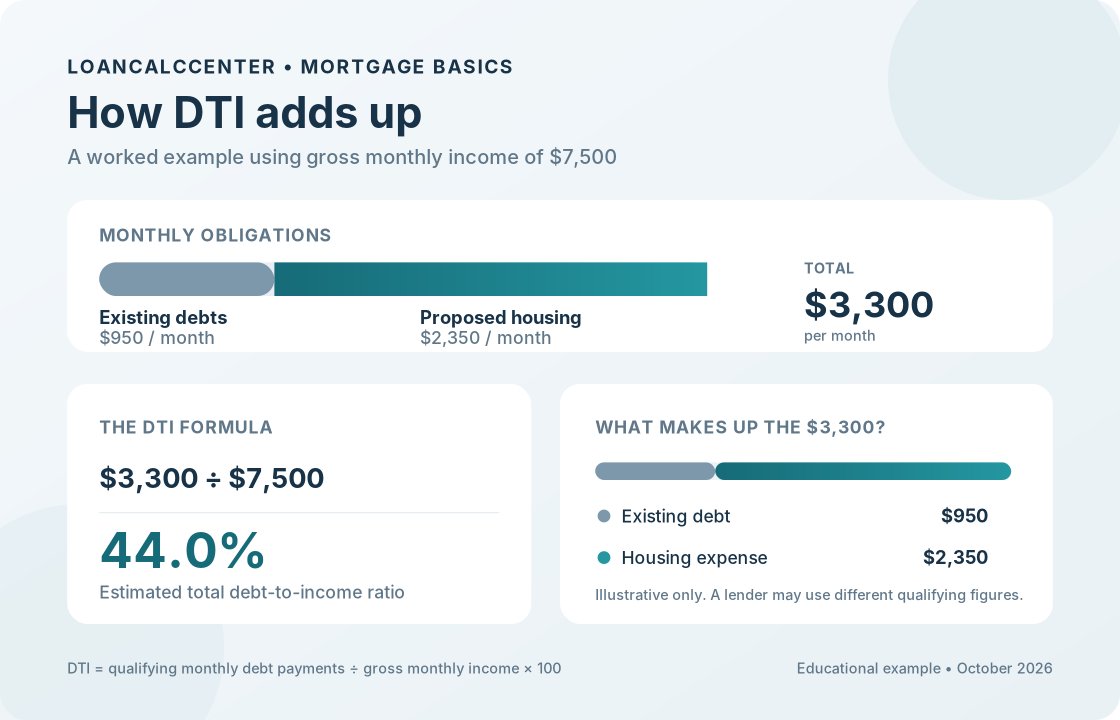
Consider a borrower with $7,500 in gross monthly income. The borrower currently pays:
| Existing monthly payment | Amount |
|---|---|
| Auto loan | $425 |
| Student loan | $250 |
| Credit card minimums | $125 |
| Personal loan | $150 |
| Total existing monthly debt | $950 |
Before adding a mortgage, those listed payments equal about 12.7% of gross monthly income ($950 ÷ $7,500).
Now assume the proposed monthly housing expense is estimated as follows:
| Proposed housing cost | Amount |
|---|---|
| Principal and interest | $1,650 |
| Property taxes | $375 |
| Homeowners insurance | $125 |
| Mortgage insurance | $100 |
| HOA dues | $100 |
| Estimated housing expense | $2,350 |
The combined monthly obligations would be $950 + $2,350 = $3,300.
- Housing expense ratio: $2,350 ÷ $7,500 = 31.3%
- Total DTI: $3,300 ÷ $7,500 = 44.0%
The example shows why the proposed housing payment matters so much. Looking only at the borrower’s current $950 in debt payments would miss the largest new obligation.
These figures are illustrative, not an underwriting result. A lender may calculate qualifying income and monthly obligations differently, and actual taxes, insurance, mortgage insurance, HOA charges, and loan terms may differ. The lender’s verified figures—not this example—control the application.
For a broader estimate of a possible home budget, try the Home Affordability Calculator alongside the Mortgage Calculator. The two tools answer related but different questions: one helps frame a possible home budget, while the other estimates a loan payment from selected loan assumptions.
Which debts count toward mortgage DTI?
The exact list depends on the loan program and underwriting rules. For Fannie Mae conventional mortgage underwriting, the monthly-obligation guidance addresses several common categories. These can include:
- Auto loans and other installment debt: Such as personal loans and many student loans. Fannie Mae generally requires installment debts with more than ten monthly payments remaining to be counted; shorter remaining terms can still matter when the payment significantly affects the borrower’s ability to meet obligations.
- Credit cards and revolving accounts: Lenders generally use the required monthly payment, not simply the outstanding balance. If a payment is missing from the credit report, the applicable guide provides a method for determining a qualifying payment.
- Student loans: The qualifying payment may depend on the payment shown by the credit report and supporting loan documents. Deferred, forborne, or income-driven loans can require additional review.
- Lease payments: Auto and other lease payments may be counted even when relatively few payments remain.
- Other recurring obligations: Depending on the circumstances, this can include child support, alimony, separate maintenance, HELOC payments, and certain tax-payment agreements.
Fannie Mae’s Monthly Debt Obligations guidance explains how these items are treated, including exceptions and documentation requirements. Do not assume a payment can be excluded just because another person informally helps pay it or because the balance is nearly paid off. Ask the lender what documentation is required.
Also, DTI is not a complete household budget. Utilities, groceries, childcare, commuting, health costs, savings, and many other everyday expenses still affect what you can comfortably afford, even when they are not counted as monthly debt in a lender’s DTI calculation.
How to lower your DTI before applying
If your ratio is higher than you would like, focus on changes that reduce the monthly obligations a lender will actually count or increase qualifying income that can be documented.
1. Review your credit reports and statements
Make a list of each balance, required monthly payment, and remaining term. Check that the accounts are yours and that the reported payment amounts are accurate. If a student-loan payment or other obligation is shown incorrectly, gather current statements and ask the lender how it can be documented.
2. Pay down or pay off a debt strategically
Paying off a small installment loan can sometimes remove a monthly payment from the DTI calculation, while paying down a credit card may reduce its required minimum payment. The effect depends on the lender’s calculation and how the account is reported. Keep enough cash for closing costs, moving expenses, and emergencies rather than using every available dollar to pay down debt.
The Credit Card Payoff Calculator can help compare repayment schedules. It estimates payoff timing and interest; it does not determine how a mortgage underwriter will treat the account.
3. Be cautious about consolidating debt
Debt consolidation may combine several payments into one, but it does not automatically improve your DTI. The new loan payment, fees, repayment term, and the treatment of the old accounts all matter. A longer term may lower the monthly payment while increasing the total amount of interest paid.
Compare the proposed payment and overall cost before making a change. The Debt Consolidation Calculator can help you model a scenario, but check the mortgage impact with your loan officer before opening a new account.
4. Avoid taking on new debt during the mortgage process
A new car loan, financed furniture, or a large credit-card purchase can add a monthly obligation or change your credit profile. Before making a major purchase on credit, ask your loan officer how it could affect an application that is already in progress.
5. Revisit the home price and down payment assumptions
A lower purchase price, a larger down payment, or a property with lower taxes and association costs may reduce the proposed housing expense. A larger down payment also uses cash that might be needed for reserves and closing costs, so compare the trade-offs rather than assuming that putting every dollar down is best.
6. Document all qualifying income
If you receive income beyond your base salary, ask the lender what history and documentation are needed before counting it. Not every source of money automatically qualifies, and lenders may apply rules for variable, self-employed, bonus, commission, or rental income.
DTI is not the same as credit score or affordability
DTI and credit score answer different questions. DTI compares qualifying monthly debt payments with gross monthly income. A credit score is based on information in a credit report and is used in assessing credit risk. A strong score does not erase a high DTI, and a low DTI does not guarantee a strong credit profile.
Likewise, a lender’s maximum allowable DTI is not necessarily a comfortable spending target. DTI generally uses gross income, before taxes and many payroll deductions. Your take-home pay is lower, and your household still needs to cover food, utilities, transportation, maintenance, savings, and irregular expenses.
A mortgage payment that passes an underwriting test can still feel tight in day-to-day life. Build a separate monthly budget before deciding what payment you want to carry.
Frequently asked questions
Is 30% DTI good for a mortgage?
A 30% total DTI is relatively low compared with many higher-debt scenarios, but the number alone does not guarantee approval or define what you can comfortably afford. The lender still reviews the loan program, credit profile, income, assets, property, and other requirements.
Is 43% DTI too high?
Not automatically. Some mortgage programs and underwriting paths may allow ratios around or above that level, while others may set lower limits. Fannie Mae’s conventional guidance, for example, distinguishes manual underwriting from DU-underwritten casefiles. Ask which guideline applies to the loan you are considering.
Can I get a mortgage with a 50% DTI?
It may be possible under certain underwriting paths, but it is not guaranteed. Fannie Mae’s guide lists 50% as the maximum allowable DTI for DU-underwritten loan casefiles. Other programs and lenders can have different rules or stricter requirements. A 50% ratio also leaves a relatively small share of gross income after counted debt payments, so review your actual take-home budget carefully.
Does rent count in DTI?
For a home purchase, the lender generally evaluates the proposed housing expense for the property being financed. Existing rental payments may be relevant in some situations, such as when a borrower will retain a rental obligation or is a non-occupant borrower. The treatment depends on the transaction and underwriting rules. Provide the lender with accurate housing information rather than deciding on your own to omit rent.
Do utilities count toward DTI?
Ordinary utility bills are generally not treated like installment or revolving debt payments in standard mortgage DTI calculations. They still matter to your personal budget and to how much housing cost you can comfortably manage. Specific recurring obligations and loan-program rules can differ, so ask the lender about unusual or contractual payments.
Does paying off a credit card improve DTI?
It can, especially if paying down the balance lowers the required minimum payment or paying off the account removes a qualifying monthly obligation. The exact effect depends on the payment reported and the lender’s method. Do not assume that a balance payment immediately changes a lender’s records; ask how updated documentation can be considered.
The bottom line
A good DTI is not one magic percentage. It is a ratio that fits the requirements of the loan program and leaves enough room in your actual budget for the costs of owning a home. Calculate it with realistic monthly obligations, understand which rules apply to the loan you are considering, and avoid treating a calculator result as an approval decision.
Start with the DTI Calculator, then compare the result with your housing assumptions using the Home Affordability Calculator. Before applying, have a lender confirm the qualifying income and monthly payments that will be used in underwriting.
LoanCalcCenter provides educational calculators and general financial information for planning purposes. Results are estimates, not loan approvals, loan offers, or individualized financial advice. Actual underwriting depends on the loan program, lender requirements, verified income and obligations, property details, and applicable law. See our Financial Disclaimer.
Sources
- Consumer Financial Protection Bureau, What is a debt-to-income ratio?
- Fannie Mae, Selling Guide B3-6-02: Debt-to-Income Ratios (2026 Selling Guide)
- Fannie Mae, Selling Guide B3-6-05: Monthly Debt Obligations (updated August 5, 2026)
- Freddie Mac, Completing your loan application